Kansai International Airport 関西国際空港
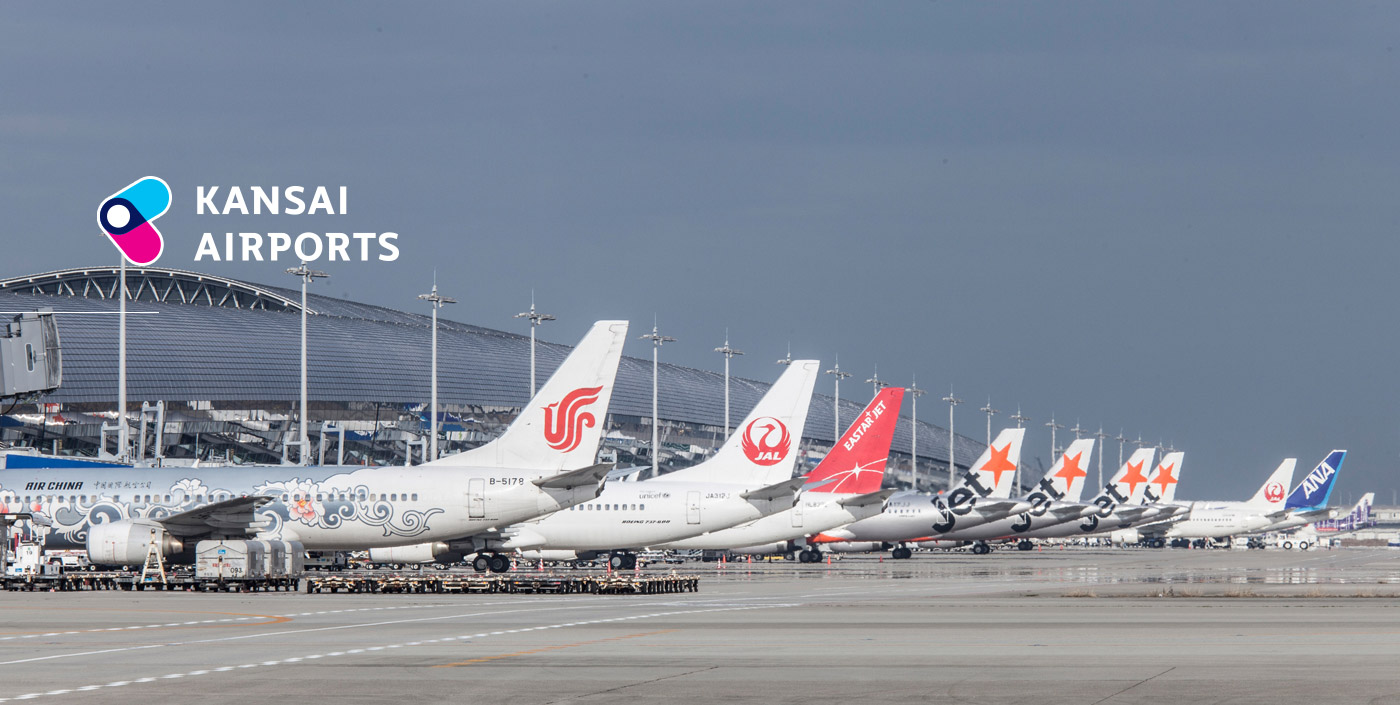
Kansai International Airport (KIX) is the main international airport for western Japan. Opened in 1994 to alleviate the demand experienced at Itami Airport, it’s become the third busiest airport in Japan. It provides both domestic and international flights to many destinations.
The airport was completely renovated for the Expo, so a few things have changed. Dining options after security are scarce and expensive. There are now four Lawsons you can turn to for the cheapest possible eats:
- Terminal 1 domestic departures (2/F) before security, turn left after entering and it’s at the end
- Terminal 1 international arrivals (1/F), in the central area
- Aeroplaza (2/F), you’ll see it immediately after entering
- Terminal 2 domestic departures before security, turn left after entering
Other cheap options are a McDonalds and Sukiya on the domestic departures floor, and Zetteria (burgers) in the Aeroplaza.
Getting to KIX
By Train
There several options by trains that run between KIX and Osaka (and beyond). This includes:
By JR West on the Kansai Airpot Line
- Kansai Airport Express “HARUKA” Service (timetable schedule here)
- Kansai Airport Rapid Service (timetable schedule here)
By Nankai Electric Railway on the Nankai Airport Line (timetable schedule for both services here)
- Limited Express “Rapi;t” Service
- Airport Express Service
You can catch the JR trains from Osaka Station and the Nankai trains from Namba Station. All services stop at the same Kansai Airport Station.
By High-Speed Ferry
URL: http://www.kobe-access.co.jp/en
Taking the high-speed ferry is the fastest and coolest way to get to KIX from Kobe. First, take the Port Liner from Sannomiya to Kobe Airport (18 mins), and then get on the ferry to KIX (30 minutes). ¥3,060 for a round-trip ticket. Be aware that the ferry only runs once an hour.
If you have a car, they offer free long-term parking (up to 28 days) on the Kobe side. Just remember to validate your ticket before boarding the boat.
By Limousine Bus
URL: https://www.kate.co.jp/en/
The limousine bus is also a convenient way to get to Kansai International. You don’t have haul your heavy luggage through train stations and there is storage room below the bus for your larger bags.
The bus is generally on time or a little bit early, but when there is heavy traffic the bus will be late. Be sure to allot some extra time just in case. You can purchase tickets at a nearby machine by the bus stop or pay with your IC card.
URL: http://www.kansai-airport.or.jp
Osaka (Itami) Airport 大阪伊丹空港
Osaka Airport, more commonly known as Itami Airport (ITM), is located in the southeast corner of Hyogo, just northwest of Osaka. It is much easier to reach than Kansai Airport, but only offer domestic flights.
Getting to Itami Airport
The most convenient way to get to Itami Airport is by the limousine bus from Osaka Station (Umeda Station area) which only takes around 30 minutes. You can also take a train, changing at Senri Chuo Station (from Osaka) or Hortarugaike Station (from Kobe) and then catching the Osaka Monorail to Osaka Airport Station. Another viable option is taking a train to either Hankyu Itami Station or JR Itami Station and catch a regular bus to the airport (around 30 minutes). Driving is also possible and there is parking on site.
URL: https://www.osaka-airport.co.jp/en
Kobe Airport 神戸空港
Kobe Airport was completed February 2006. The airport was built as an extension off of Port Island, just south of Sannomiya, and serves the Hanshin area predominantly with domestic flights. Recently in 2025, they have started offering international flights to China, Taiwan and Korea.
Food after security in both domestic and international terminals is limited to a single cafe (domestic) or snack shop (international). If you arrive at the airport hungry, you’ll want to eat or stock up before security in the domestic terminal before going to the gate area. If driving, there’s an IKEA just before the bridge to the airport with very affordable grab-and-go options (100 yen for a hot dog or 250 yen for vegan karaage).
Getting to Kobe Airport
The most convenient way to get to Kobe Airport is by the Port Liner, a train shuttle from Sannomiya Station which roughly takes about 18 minutes. Other methods include bus services (connecting Shin-Kobe and Sannomiya, but also other further destinations across Hyogo) and the high-speed ferry (from Kansai International). You can also come by car and parking is available on site and free for the first 24 hours as long as you validate your parking voucher in the gate area.
URL: https://www.kairport.co.jp/en
Tajima Airport 但馬空港
Tajima Airport, otherwise known as Konotori Tajima Airport, is based in Toyooka. This is the domestic airport for northern Hyogo which exclusively has two departing and two returning flights per day (in the morning and in the evening) between Itami Airport operated by JAL. It markets itself as the quickest way to get to Tokyo by just under 3 hours.
Getting to Tajima Airport
It takes around 15 minutes from JR Toyooka Station and 40 minutes from JR Kinosaki Onsen Station by bus. Though the most common method to get there is by car and there is free onsite parking. For those living and/or working in the Tajima area (Asago, Kami, Shinonsen, Tooyoka, Yabu) and Kitakinki (Tanba, Tanba-Sasayama), there is a subsidy that you can apply for to get steep discounts.
Airports outside of Kansai
Okayama Airport 岡山空港
Okayama Airport, also known as Okayama Momotaro Airport, opened in 1988 and mainly serves the Chuugoku and eastern Shikoku region. It offer domestic flights to Tokyo, Sapporo and Okinawa and international flights to China, Hong Kong, Taiwan and Korea. This airport works well for those living in the western part of Hyogo (around the Himeji area), which is relatively close via the Sanyo Expressway (around 1.5hrs drive from Himeji) and has free parking. If you’re unable to drive there, you can also take a shinkansen to Okayama Station and catch an airport bus for 1000yen one way.
URL: https://www.okayama-airport.org/en/
Tottori Airport 鳥取空港
Tottori Airport, also known as Tottori Sand Dunes Conan Airport, opened in 1967 and mainly serves the San’in region. It only offers domestic flights to Tokyo, operated by ANA. With its close proximity to northern Hyogo (around 1.5hrs drive from Toyooka toll-free) and free parking for up to a week, it is also another viable alternative for easy access to Tokyo, with only a flight time of just over an hour. If you’re unable to drive there, you can also take a train to Tottori Station and catch an airport bus for 480yen one way.
URL: https://www.ttj-ap-bld.co.jp
Flying overseas: departure and arrival procedures
Credit to Ceci for the following information
At an international airport, such as KIX, there is a special procedure for people with residence cards when going through immigration.
First, you will need to join the queue with a sign for “Special Residents” or “Residence Card Holders”. There may be another sign with a picture of a residence card to guide you. Get your residence card out before you join the queue, as often there will be a staff member there to prevent the wrong people from joining (I have been body-blocked before, so just show them your residence card to avoid this!).

Second, you must fill in a short form (see above) called a re-entry departure record (sainyuukoku kyoka). This form requires basic information like your name and travel details. It can be collected from a stand or rack after you have entered the queue area. I recommend picking up multiple copies so that the next time you leave Japan, you can fill it out at home to save time.
Third, once the form is completed, join the queue. Sometimes this line is empty and sometimes it is extremely busy. This depends on the airport, as some use the same queue for families and residence card holders. At KIX, wait times can be up to 45 minutes here.
Finally, give the immigration officer the completed form, along with your passport and residence card. They will take half of the form (the departure part) and staple the other half into your passport. Do not remove this, as immigration will remove it upon re-entering Japan.
When coming back to Japan, similar to the departing procedure, find the “Residence Card Holders” section and join the queue. Wait times vary again depending on the airport and/or arrival time. The immigration officer will get you to scan your fingerprints again and remove the stapled part of the re-entry departure record. Prior to coming back to Japan, a good tip is to fill out the Visit Japan Web form on your phone in order to have a seamless time through quarantine if you have nothing to declare. This skips the need to fill out a paper form and join a long queue and instead show the QR code and move to the exit quickly.
Domestic and International Travel
Credit to Jason Yang for the following information
On Domestic Travel
Unlike in many developed countries around the world, Japan makes it very easy to travel domestically by air. As long as you’re flying with a full-service (ANA/JAL) or semi-budget airline (Skymark, AirDo, Solaseed, StarFlyer) check-in takes a few minutes at most and security is simplified, with no ID check and a much larger limit on liquids (average-size drink, skincare product, etc bottles are no issue). You can arrive an hour before departure and still make it to your flight; you only have to be through security half an hour before departure (your boarding pass will not scan at security past then). Truly budget airlines like Jetstar and Peach may check ID and require you to arrive a little earlier, but that’s an airline policy and not a government requirement.
Tips
- Most liquids are allowed, but resealable or opened containers sometimes need to be specially scanned, which will take extra time (about 2-3 min per container).
- Double-check luggage limits before booking. The true budget airlines, Peach and Jetstar, have a strict 7kg carry-on limit and the cost of checking a bag or increasing the carry-on limit (and the cost to get to Kansai Airport) may make it cheaper to fly a full-service or semi-budget airline from a closer airport. With full-service or semi-budget airlines the limit is usually 20kg across all bags.
- If you’re connecting to an international flight, be aware that even in the same airport, the international departure may be in a different terminal than where your domestic flight arrives, so be sure to leave enough time to get to your connecting flight. Also, you’ll need to put larger liquids in a checked bag when you make the transfer.
- If you’re going to Okinawa, due to some special rules in place, you’re allowed to shop at designated duty-free stores in town and at the airport on your return. Whether it’s actually worth doing so varies depends on what you’re buying, so make sure you look online to compare prices before deciding.
On International Travel
Kansai Airport is the most developed and has the widest variety of nonstop international flights, and is where the majority of budget airlines fly out of, but Kobe Airport and other regional airports are less crowded and can be a less stressful experience.
If connecting in Tokyo, try to avoid a Haneda-Narita transfer if possible; travel time between the two is around 2 hours and any delays or cancellations along the rail network can result in missing your flight. If booked on one ticket, your connection will be rebooked, but this still means a delay, possibly until the next day.
If you plan on traveling internationally out of Kansai Airport or connecting in Tokyo more than once or twice a year, sign up for automated gate access (自動化ゲート利用登録). It costs nothing, and can really save time, especially in Kansai Airport Terminal 2 (the budget airline terminal) where immigration lines for returning residents can stretch almost as long as the tourist line. In all airports where machines are available, the enrollment counter is at the end of the departure immigration area, near the diplomatic/crew line. Budget half an hour for the application procedure, and ideally arrive with this form printed out and filled in. Once you’re signed up, you’ll be able to use the fingerprint-type automated gates for 3 years or until your residence card expires. This means no waiting in line (or at most one or two other people), although you’ll still need to fill out the departure/re-entry card.
