Last updated: July 2025
With numerous different train companies in Japan, hundreds of train lines and heaps of people all trying to cram on the same train, public transit can be a little overwhelming at times. The following information should hopefully help make traveling on trains a little easier.
Travel between Himeji and Osaka

There are three major train lines for travel in the urban Himeji-Osaka corridor of Hyogo:
– Sanyo/Hanshin (山陽/阪神)
– JR West
– Hankyu (阪急) (up to Kobe Sannomiya)
Think of three parallel train lines in an east-west orientation along the coast. The southernmost line is the Sanyo Line, which travels from Osaka to Himeji. The section of this line between Osaka (大阪) and Kobe (神戸) is better known as the Hanshin (阪神)Main Line, and sometimes offers direct access to Nara.
In the middle, the JR Kobe Line travels between Himeji and Osaka and also provides direct access to Kyoto. Along this line at major stations like Amagasaki, Kakogawa and Himeji, JR West also provides direct access to various locations in northern Hyogo (Tamba and Tajima region) and to the west of Himeji.
The Hankyu Kobe Main Line is the northernmost line and has the fanciest cars. It runs between Kobe and Osaka, with connections to Kyoto. Hankyu also runs branch lines connecting the cities of Amagasaki, Nishinomiya, Itami and Takarazuka.
Within Kobe
The Kobe Subway (神戸市営地下鉄) has two different lines. The Seishin-Yamate Line (西神山手線) runs between Tanigami (谷上) and Seishin Chuo (西神中央) stations. Take this line toward Tanigami to get to JR Shin-Kobe Station to catch the shinkansen (bullet train). The Kaigan Line (海岸線) runs between Shinnagata (新長田) and Sannomiya (三ノ宮). See here for the timetable (Japanese only).
There is also the Port Liner(ポートライナー線) and Rokko Liner(六個ライナー線), which serves the artificial islands of Port Island and Rokko Island respectively. The Port Liner gives easy access to Kobe Airport, Port of Kobe and IKEA.
Shinkansen

The Sanyo Shinkasen (山陽新幹線)is the only shinkansen line to run through Hyogo. Operated by JR West, it links between Osaka (Shin-Osaka Station) and Fukuoka (Hakata Station). Within Hyogo, there are four shinkansen stations:
| (towards Okayama/Fukuoka) | Aioi (Aioi) | Himeji (Himeji) | Nishi-Akashi (Akashi) | Shin-Kobe (Kobe) | (towards Osaka/Tokyo) |
Shin-Kobe and Himeji are major stations, where all (if not, majority) of the shinkansens will make a stop to and from Osaka/Fukuoka and beyond. For the minor stations of Nishi-Akashi and Aioi, these will be serviced by slower shinkansens (those that make a stop at every station) and may require you to change at Shin-Osaka if you are heading towards Kyoto, Nagoya or Tokyo.
Other Lines
JR West
- Ako Line
- Between Himeji and Okayama, connecting Tatsuno, Aioi and Ako
- Bantan Line
- Between Himeji and Asago, connecting Fukusaki, Ichikawa and Kamikawa and tourist sites like Ikuno Silver Mine and Takeda Castle. Links up with the Sanin Main Line at Wadayama.
- Fukuchiyama Line
- Also known as Amagasaki Line. Between Osaka and Fukuchiyama, connecting Amagasaki, Takarazuka, Sanda, Tamba-Sasayama and Tamba. Links up with the Sanin Main Line at Fukuchiyama.
- Kakogawa Line
- Between Kakogawa and Tamba, connecting Ono, Kato and Nishiwaki before linking up with the Fukuchiyama Line at Tanikawa.
- Kinshin Line
- Between Himeji and Niimi (Okayama Prefecture), connecting Tatsuno and Sayo. An alternative way to travel to Tottori by changing at Sayo.
- Sanin Main Line
- The longest continuous JR line in the country, connecting between Kyoto to Yamaguchi. Connects the northern part of Hyogo, between Asago and Shin-onsen. Covers the popular areas like Kinosaki Onsen and Amarube Viaduct.
- Sanyo Main Line
- Continuation of the JR Kobe Line, running west of Himeji (overlaps with Ako Line), connecting Tatsuno, Aioi, Ako and Kamigori. Frequency of trains drop quite significantly compared to the Kobe Line.
- Wadamisaki Line
- Very short branch line in Kobe, connecting two stations. Gets frequent use for major events at Noevir Stadium.
Kobe Electric Railway (Shintetsu)
- Arima Line
- Runs between central Kobe and Arima Onsen, connecting the northern ward of Kobe.
- Sanda Line
- Runs between Kobe and Sanda. Connects from the Arima Line.
- Koen-Toshi Line
- Connects Sanda Station to the suburbs of Sanda.
- Ao Line
- Connects the northern ward of Kobe to Ono, running through Miki.
Hanshin
- Hanshin Mukogawa Line
- Branch line within Nishinomiya, connecting Mukogawa to Mukogawadanchimae.
- Hanshin Namba Line
- Connects Amagasaki to Osaka Namba. An alternative way to get to Osaka and a through connection to Nara.
Hankyu
- Hakyu Itami Line
- Connects Amagasaki to Itami. Take a bus from Itami to get to Itami Airport.
- Hankyu Imazu Line
- Connects Nishinomiya to Takarazuka. Transfer at Takarazuka for the JR Aamagasaki Line.
- Hankyu Koyo Line
- Within Nishinomiya, connects the northern part to the main line. Runs along the Shukugawa Park, a very picturesque area during hanami.
- Hankyu Takarazuka Line
- Connects Takarazuka to Umeda in Osaka. Change at Hotarugaike Station to get to Itami Airport.
Other
- Chizu Express Chizu Line
- Runs between Kamigori to Chizu (Tottori), with a through connection to Tottori. An alternative albeit slow way to reach Tottori.
- Hojo Railway Hojo Line
- Rural rail line connecting Ono and Kasai. Alternative and very slow way to access Kobe with many transfers.
- Kyo Tango Miyazu Line
- Tourist train connecting Fukuchiyama and Toyooka. Runs through the famous Amanohashidate in northern Kyoto.
- Nose Electric Railway Myoken Line
- Branching off the Hankyu Takarazuka Line, serving Kawanishi and connects to Toyono (Osaka)
- Nose Electric Railway Nissei Line
- Off the Myoken Line. Connects Kawanishi and Inagawa (the only station in Inagawa)
Fares
Most stations will have an area near the ticket gate where you can purchase tickets or top up your IC card. Fares can range anywhere from a couple hundred yen to almost 2000 yen depending on the distance you travel. At the ticket machine, you select your destination and pay through cash (credit/debit card not accepted). You can also purchase shinkansen tickets at major JR stations or reserve them online through Smart-EX.
Apart from physical tickets, there are contactless travel cards called an IC card (different brands across Japan but ICOCA is for the Kansai area). You can purchase this at a JR station with a 500 yen refundable deposit alongside you first top-up. Not all stations/buses accept IC cards (particularly the rural ones) so be aware about that and purchasing a paper ticket might be the only option. You are also unable to use your IC card for shinkansen travel (you can link it to Smart-EX but you’ll still need to pay/reserve your ticket prior to travel).
For iPhone users, you can also set up a digital IC card (Suica, PASMO or ICOCA) through the Apple Wallet (beware that transferring your physical IC card to a digital one is non-reversible, rendering the physical one useless after transfer). The digital IC card does have some advantages, namely being able to top up through Apple Wallet and not worrying about losing the card (though losing your phone is a downside as well). You can put your phone at the IC terminal and top up by cash just like a physical IC card. You can also turn on ‘Express Transit’, which doesn’t require you to wake or unlock your iPhone at the ticket gate as it will just instantly read the relevant card just like a physical one.
For Android users, unfortunately the digital equivalent through their Google Wallet app is only available on devices purchased in Japan as it comes with a special chip that acts like a IC card. Apparently Google does have that chip in its Pixel devices but somehow they’ve disabled it on devices purchased overseas.
Recently some transport operators are allowing customers to pay via Visa, Mastercard or AMEX branded contactless cards. However it is still early days and not all areas accept them.
Handy Navigation Tools
Google Maps
- Probably the best and easiest to use, both on desktop and mobile.
- Available in English and Japanese.
- Find info on train times, transfers, fares, etc.
- Enter your starting point and destination without needing Japanese.
- Can adjust the date and time of your desired departure.
- You might have to refine the station or place names (e.g., there is more than one Sannomiya)
- You can also select whether you want to include trains/cars/walking in your search options.
- Multiple course options shown depending on your travel preference.
Yahoo Train Schedule
- This site is only available in Japanese.
- Use this site to find info on train times, transfers, fares, etc.
- Enter your starting point and destination. You can type the station name in roman letters, kana, or kanji.
- Can adjust the date and time of your desired departure.
- You might have to refine the station names (e.g., there is more than one 三宮)
- You can also select whether you want to include express trains or airplanes in your search options.
- Press “検索” and you will be given a number of course options to choose from.
JR Odekake
- This site is only available in Japanese.
- Limited to JR West service area (though information is available for larger stations like Tokyo)
- Use this site to find info on train times, transfers, fares, etc.
- You may view complete, current time tables for the various lines providing service at each station.
Japan Travel by NAVITIME
https://japantravel.navitime.com/en/area/jp/route
- Site available in English.
- Very simple and easy to use interface
- Can adjust the date and time of your desired departure.
- Can filter by transport mode and rail pass.
Useful Train Vocabulary
General Vocab
| Vocabulary | Romanji | Meaning |
|---|---|---|
| 改札口 | kai-satsu-guchi | Ticket Gate |
| 片道 | kata-michi | One way |
| 往復 | ou-fuku | Round Trip |
| グリーン車 | green-sha | First Class Car |
| 禁煙車 | kin-en-sha | Non-smoking Car |
| 喫煙車 | kitsu-en-sha | Smoking Car |
| 自由席 | ji-yuu-seki | Non-reserved Seat |
| 指定席 | shi-tei-seki | Reserved Seat |
| 窓側 | mado-gawa | Window (Seat) |
| 通路側 | tsuu-ro-gawa | Aisle (Seat) |
| 座席番号 | za-seki-ban-gou | Seat Number |
JR
| Vocabulary | Romanji | Meaning |
|---|---|---|
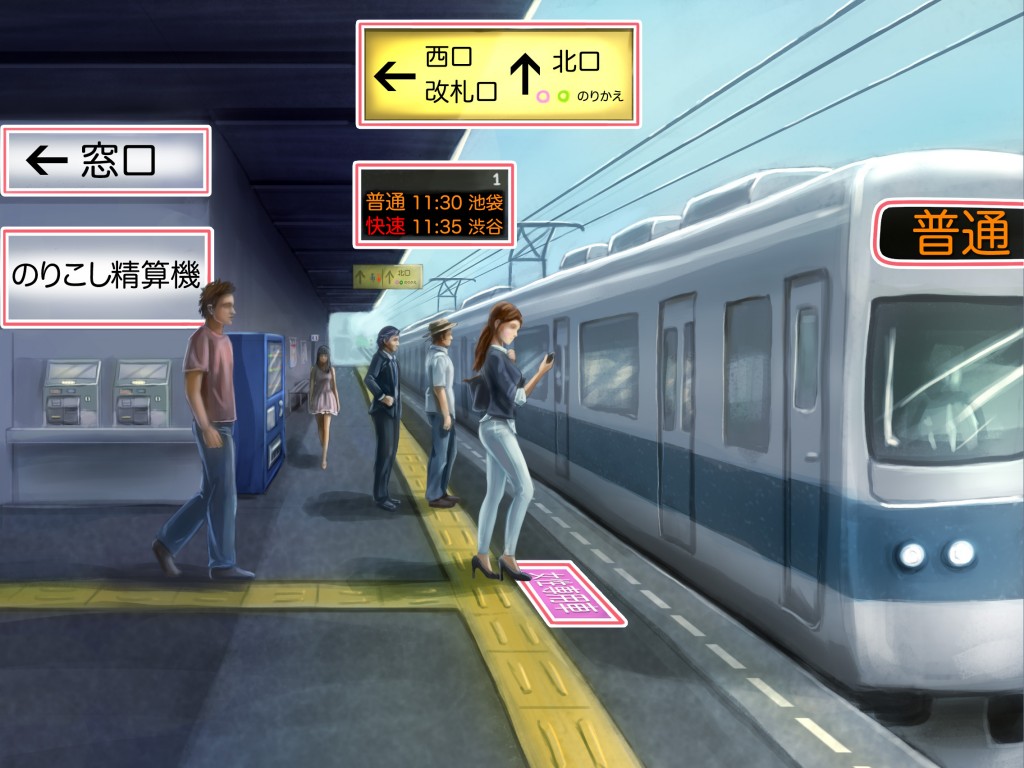
| 普通 | fu-tsuu | Local |
| 快速 | kai-soku | Rapid Service |
| 新快速 | shin-kai-soku | Special Rapid Service |
| 特急 | tok-kyuu | Express |
| 新幹線 | shin-kan-sen | Shinkansen (Bullet Train) |
| 長距離列車 | chou-kyo-ri-ressha | Long-distance Train |
| 緑の窓口 | midori-no-madoguchi | Green Ticket Window (For Reserved Seats, Shinkansen, etc.) |
Hankyu/Hanshin
| Vocabulary | Romanji | Meaning |
|---|---|---|
| 普通 | fu-tsuu | Local |
| 急行 | kyuu-kou | Express |
| 快速急行 | kai-soku-kyuu-kou | Rapid Express |
| 特急 | tok-kyuu | Special Express |
| 直通特急 | choku-tsuu-tok-kyuu | Direct Express |
Trains and Traveling Tips
The Himeji-Osaka Corridor
- All four types of JR trains operate on this line: Local (futsuu), Rapid Service (kaisoku), Special Rapid Service (shinkaisoku) and Limited Express (Tokkyuu).
- The Shinkaisoku are the best trains to catch if you want to travel from Himeji to Kobe/Osaka directly, since it only makes a few stops on the way and costs the same as the Futsuu and the Kaisoku. The Tokkyuu is the only train that requires an extra charge (a second ticket).
- Before you get on the Kaisoku, Shinkaisoku or Tokkyuu, make sure that it stops at your station! If it doesn’t, you have to ride all the way to the next station, switch to a local train and come back.
- Also, be careful not to take the long distance express train (Choo-kyori-ressha). They are big, and are usually beige, red, white, or pink & blue trains that are super expensive and requires a reservation.
Travelling between Northern & Southern Hyogo
- There are three viable options for regular trains, along the Bantan Line between Wadayama and Himeji, Kakogawa Line between Tanikawa and Kakogawa, and Fukuchiyama Line between Sasayama and Amagasaki. Services and wait times vary and expect to transfer from one train to another.
- You can also take the long distance express trains (i.e. Konoutori, Hamakaze) that run along these lines. While these trains are comfortable, they can cost almost twice the regular fare. These trains need to be booked in advance and cannot be paid with an IC card. Nevertheless, for long trips (i.e. from Amagasaki in southern Hyogo near Osaka, to Hamasaka in far northern Hyogo, near Tottori) they can save you up to 5 hours of commuting time.
- When taking the regular trains, be aware that not all stations have an IC card reader. Even though the station you are starting from have one, you should instead purchase a paper ticket if your destination doesn’t have one.
Getting on the right train
- Japanese trains are very punctual. It is a rarity for trains to be late, so make sure you’re early to the platform! That said, the train crash in Amagasaki has forced JR to crack down on speeding. This means that you can expect more delays than usual. On every platform there is a large timetable listing train times for weekdays and holidays (the sign only says “Saturdays, Sundays & Holidays”). Local train times are usually designated by black numbers, while express trains are in red, yellow, blue, etc. If you catch the wrong train, wait to get off at a large station, so you can quickly catch a train going back the other way.
Discount train ticket shops
- Even though it can often be cheaper to go abroad during your holidays, if you want to see Japan you can save on traveling expenses by going to discount ticket agents. These are perfectly legitimate shops that buy group tickets and sell them at bargain prices. These shops sell unreserved, open ended tickets.
- If you are traveling on JR, take the ticket you bough at the discount shop to the Midori-no-Madoguchi and ask them to make it a reserved ticket. This can be done free of charge. You usually save 10-20% off of the normal ticket price, so this is an especially good way to buy tickets for the Shinkansen. You can also get domestic airline tickets, but it is trickier because you can only do so one month in advance of departure. These shops are usually clustered in the the around major stations. Most shops also sell discount movie, concert, exhibition, and amusement park tickets, too.
Discount Train Tickets
Commuter Passes (Teikis – 定期)
If you’re going to be taking the same route often you might want to invest in a Teiki. When you buy a teiki, you choose two stops and the time period you want (you can buy teikis in increments of 1-month, 3-months, and 6-months). During that time period, you will be able to get on and off anywhere between your two stations. The system is set up for commuters, and unless you are taking the same trip every day, it won’t save you too much money. For example, for a trip that costs ¥280 on the Hanshin line, a one month teiki costs ¥11,500. You would then have to make that trip at least 42 times in the month to make it worth the investment (21 round-trips).
JR Regional Passes
JR offers special regional passes that typically goes for 3-days. The passes are available for the JR West coverage area are the Kansai Wide Pass, JR Kyushu, and JR East. If you will be traveling a lot within one of these areas during a part of the year that you cannot buy a Seishun-18 ticket, these passes can save you a lot of money off of normal train fairs.
Seishun-18 Train Tickets (青春18 切符)
Another offering by JR, this seasonal ticket can be purchased around the three school holiday periods each year. They offer two types, a 3-day for ¥10000 and a 5-day pass for ¥12050. The recent changes have made it less flexible and attractive, where it removed the ability to travel throughout the period of the pass non-consecutively and can only be used one per person (use to be able to have 5 people on one pass). Nevertheless, if you’re planning for a long weekend trip and travelling to many places by train, this could work out to be a great deal for you.
